Archive for the ‘Performance’ Category

Youtube, Chasing Shadows

Tuesday, January 25th, 2011

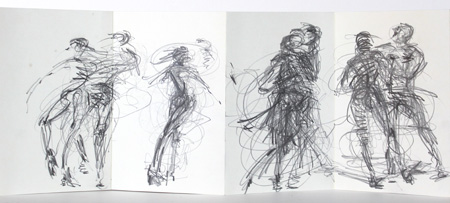
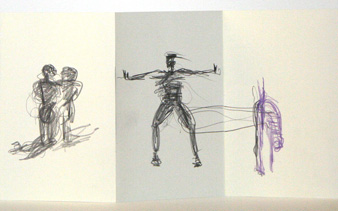
In May 2009 I had a 6 week solo show Chasing Shadows in the West End gallery, GV Art in Marylebone. Martin Smith and Alex May of Quadratura were commissioned to create an audio/visual composition of dancer, Alessandra Ruggeri, responding to my work.

On Wednesday, Thursday and Friday evening Alessandra Ruggeri will be dancing at Dancing The Decade, the 10 year celebration of The Wapping Project, with Andrew Graham in the duet, In One Breath.

A fragment of Edits at The Wapping Project

Wednesday, January 19th, 2011

On Friday and Saturday choreographer Lea Anderson and two dancers from her all male company The Featherstonehaughs, were at The Wapping Poject as part of the celebration. Ryen Perkins-Gangnes and In Pang Oci performed a stunning fragment from the 2010 show Edits.

Featherstonehaughs, Edits, Wapping Project

Ryen and In Pang perform a duet from Edits 

I drew during some the rehearsals for this show last year, it takes as it’s starting point the rhythm and phrasing of film editing in feature films. (see August 21st and August 23rd). The costumes are by Sandy Powell, music by Steve Blake and Will Saunders and light and stage design by Simon Corder. Lea Anderson first came to The Wapping Project 17 years ago with a site specific performance performed by her all female dance company, The Cholmondelys, in the building before it’s refurbishment.

Before and after the duet a lively Rock n’ Roll class was in progress on the dance floor, the dance teacher even managed to persuade me to abandon drawing them and join in!

Rock ‘n Roll, Wapping Project

Rock ‘n Roll class in progress on the dance floor


In One Breath and Quasi at Wapping Project

Saturday, January 15th, 2011

Andrew Graham is to perform his solo, Quasi and repeat the duet In One Breath with Alessandra Ruggeris on 26th, 27th and 28th January, (replacing the advertised performance by Maresa Von Stockert) at Dancing the Decade at The Wapping Project. (see post January 12th).


Andrew Graham, Alessandra Ruggeri

Andrew was selected to represent all UK art students at La Lieu Unique in Nantes for the Neu/Now Festival in October 2010.

Alessandra has just finished dancing in Wagner’s Opera, Tannhauser at The Royal Opera House.

Move: Choreographing You, last day

Friday, January 14th, 2011

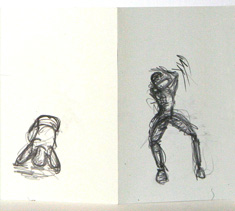
Many of the same dancers who performed last Friday evening at the Wapping Project have been dancing at the exhibition Move: Choreographing You at the Hayward Gallery over the last 3 months, (see post November 3rd).  I was asked by the facilitator, Susan Sentler and several dancers, to join them on Sunday and draw at the last day of the exhibition.

A new work was performed by students of Trinity Laban Conservatoire of Music, in The Clore Ballroom at The Festival Hall. Composer, Earle Brown, originally associated with John Cage and Merce Cunningham, wrote the score for December 1952 describing it as “a field of activity“.  Seating was arranged to mimic the graphic score, the performers (including musicians) weaved and danced between chairs utilising all the space.

December 1952 December 1952

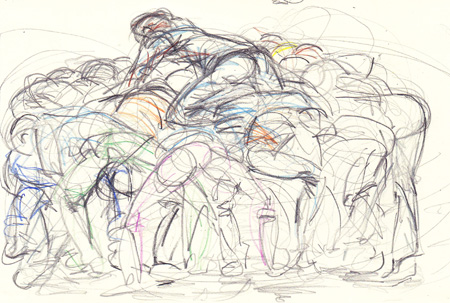
Simone Forti‘s Huddle, an impromptu ‘dance construction’, took place at different times and places within the gallery throughout the 3 months. On Sunday, the last day, all the dancers who’d worked at the exhibition over the last 3 months came in specially to join together and create a massive Huddle at the close of the exhibition.

Huddle

Two dancers link their arms round each others waist curving their backs, heads down, more join appearing out of the crowd that’s gathering.  As they come together there is an air of expectancy, a hush descends as onlookers gather around the group. As more of them join they became as if one being, one body, one breath. Slowly one dancer rises and climbs onto and across the others’ backs, another climbs up and across, then another. A silent sculptural gently moving form, totally mesmerising and engaging… suddenly they break free from each other laughing to spontaneous clapping and cheering.

Matthew Bourne’s Cinderella

Wednesday, December 22nd, 2010

Prokofiev wrote the score to Cinderella during the Second World War, premiered by the Bolshoi in 1946. Matthew Bourne was intrigued and inspired by this discovery, he explored the possibility of setting Cinderella during this period, saying “…it seemed to work so well in the wartime setting. Darkly romantic in tone, it speaks of a period of time when time was everything, love was found and lost suddenly and the world danced as if there was no tomorrow.”

New Adventures Cinderella. 2 Cinerella, 3New Adventures Cinderella 4 New Adventures Cinderella 7New Adventures Cinderella 8 New Adventures Cinderella 9

Cinderella in this setting made sense to me. I grew up with stories of London in the Blitz. My mother was a physiotherapist at The London Hospital in Whitechapel (now The Royal London Hospital) during the Second World War. Stories of leaving the hospital on nights off to dance and returning to find the walk ways to the hospital bombed and impassable; treating survivors after many were horrifically crushed to death attempting to enter Bethnal Green Tube Station during an air raid; her friend, never to love another, after her boyfriend was killed soon after signing up.

New Adventures‘ production of Cinderella is performed at Sadler’s Wells until 23rd January and then goes on tour.

Russell Maliphant at Laban Theatre

Tuesday, December 7th, 2010

The work of dancer and choreographer Russell Maliphant was showcased at Laban Theatre on 24th and 25th November. The programme contained three works, opening with a film-screening of an early duet, Critical Mass; Maliphant himself dancing the solo, Shift; followed by the most recent AfterLight (Part 1) performed by award winning dancer Daniel Proietto.

 Russell Maliphant in Shift

A collaboration between Russell Maliphant and lighting designer, Michael Hulls, with haunting cello music by Shirley Thompson. Shift is in essence a solo, but shadows appear, vanish and reappear on the back screen multiplying the dancer, so he is never alone until the last phrase of movement when each column of light fades,  leaving Maliphant a silhouette, seeming to dissolve with the light as it slowly fades away.

Russell Maliphant in Shift


 Shift 


AfterLight (Part One) is inspired by the photographs and geometric circular drawings of Vaslav Nijinsky which he drew to describe his descent into psychosis. The solo is performed to piano music of Erik Satie. Michael Hulls has designed exquisite lighting, the audience are in complete darkness, (my pencil couldn’t locate my sketch book, no drawings). The dappled light falls on the dancer seeming to trap him in the shadows, as he moves he starts to spin as if casting off the darkness that enveloped him, the movement flows in spirals and circles, pools of light partially illuminating him as he moves. The climax is the dancer spinning so fast in an arc of dappled light, it is impossible to tell where his limbs end and the shadows take over. A collective sigh rose from the audience as the dancer slowed, the light faded and shadows enveloped the audience once more.

Wayne McGregor/Random Dance: Far

Thursday, December 2nd, 2010

Random Dance was founded by Wayne McGregor in 1992. The work is experimental, embracing new technology, science and visual art. The ten dancer ensemble are not afraid to push their bodies to explore physical extremes in movement; rapid, sometimes intensely angular moves are demanded of them in the choreography. McGregor says “I’ve always been interested in the body slightly misbehaving”.

Far 5

The title of the dance, Far, is an abbreviation of Roy Porter’s Flesh in the Age of Reason, a history of 18th Century explorations into body and soul.

Random Dance: Far

The music is composed by Australian electronic composer, Ben Frost.

Random Dance: Far

A large panel of lights sits low down at the back of the stage, designed by lighting designer, Lucy Carter. Throughout the dance the lights seem to act kinetically as if affected by the dancers movement.

Random Dance: Far

When I’ve watched and drawn something that totally engages me, all I want is to see and draw again, but the company are now on tour not returning to the UK until March 2011, to Laban and Snape Maltings – both venues that I have exhibited at. The performance I watched was at Sadler’s Wells.


Simon Mulligan Quartet at the 606 Club

Tuesday, November 30th, 2010

Simon Mulligan 2 Simon Mulligan 1

Last night I watched the Simon Mulligan Quartet at the 606 Club in Chelsea, it was the most beautiful jazz piano I have ever heard.

Thank you and Happy Birthday Simon Mulligan.

Rotor at Siobhan Davies Dance

Friday, November 26th, 2010

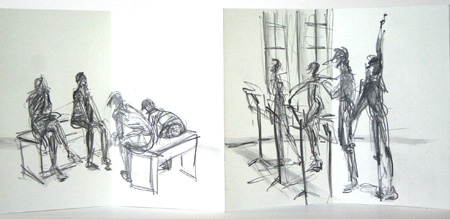
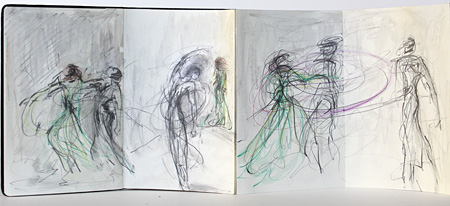
Four dancers move at varying speeds following a circular path. The central figure walks, the outer performer is running, changing direction they make comments to each other as they run again, increasing the speed until you in the audience start to feel caught up in it and dizzy. This new dance, A Series of Appointments choreographed by Siobhan Davies, was performed in the beautiful Roof Studio of Siobhan Davies Dance Studios. Later a film is shown of the dance shot from above and projected onto the studio floor, highlighting the patterns created by the dancers movement.SDD 1
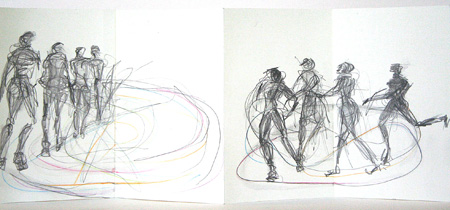
The dancers stop, seeming to take time out, sit on two benches facing each other, continuing with comments, the words are from playwright E.V. Crowe, they are performing Live Feed.

The dancers, directed by composer Matteo Fargion, stand in a line in front of music stands and perform Songbook, creating a song out of simple gestures and (often comical) noise.SDD 2
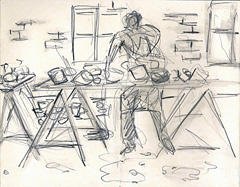
Gill Clarke, known to many for her strong dance technique classes (she taught and inspired me years ago) performed in ceramicist Claire Twomey’s installation. The room was filled with unfired ceramic pots, on tables and on the floor. Ceremoniously water was poured into one pot at a time. The water collapsed the unfired pot and water flowed out on to the floor.
Is It Madness. Is It Beauty

On the ground floor Sam Collins‘s The Conversation Revolved showing the dinner party scene from the Hitchcock film, The Suspicion fractured by mirrors and repeated in a circular formation. Really clever.

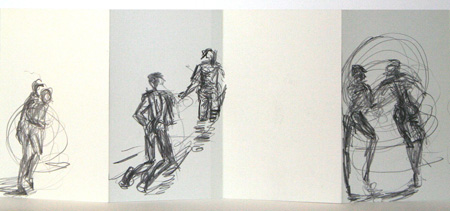
I went on the last day, I wish I’d gone on the first so I could have returned, the whole afternoon was fascinating and inspirational. I have drawn the company during rehearsals for In Plain Clothes in 2006 and Two Quartets in 2007 and The Collection during performance at Victoria Miro Gallery in 2009.
Emanuel Gat Dance, Winter Variations

Tuesday, November 16th, 2010

Two men in plain clothes dance for an hour on a big empty stage, sometimes shadowing each other, sometimes alone, sometimes in perfect unison.

Gat 1

It’s as if they are reading each others minds and responding without the need of sight. They rarely touch, rarely acknowledge one another with even a glance, but their muscular bodies seem to hold an empathy with each other.

Winter Variations grew from a shorter dance, Winter Voyage, also created and danced by Israeli choreographer Emanuel Gat and Roy Assaf. Performed at Sadler’s Wells and on tour as part of Emanuel Gat Dance‘s current programme.

Gat 4

A year ago I drew Emanuel Gat with Candoco Dance Company rehearsing ITranslation. This lyrical, beautiful dance was recently performed at London’s Queen Elizabeth Hall on the Southbank as part of Candoco’s touring show Rendition’s. He works the dancers hard, creating an energizing supportive space, with clear intentions.

Gat 3

Winter Variations is meticulous in detail, the dancers never falter. Throughout the dance the relationship and mood shifts between playful, mournful, sensual ending with isolation. Music ranges from Schubert, to The Beetles urban “Day in the Life” moving on their knees; a song by Egyptian Riad al Sunbati to Gustav Mahler’s Song of the Earth, to which the men dance in tactile sensual unison, only to agonizingly separate.

.Gat 16